Short answer: For B2B support that mixes quick how-to questions with issues that need investigation, Pylon is the strongest fit, because its agents work inside the help desk with account, CRM, call, and codebase context. Fin is a strong pick for high-volume questions a knowledge base can answer. Decagon and Sierra build branded customer-facing agents for large consumer brands. Zendesk AI makes sense if you're staying on Zendesk.
Disclosure: this post is published by Pylon. We stick to what each vendor says on its own public pages, and we checked every competitor claim on November 3, 2026. Where a competitor is the better fit, we say so.
What are the best agentic customer support platforms?
The agentic customer support platforms most B2B teams shortlist in 2026 are Pylon, Fin, Decagon, Sierra, and Zendesk AI. They differ most on 3 things: what context the agent can load, whether the agent lives inside a help desk, and how you pay.
Most AI support agents were built for lots of customers asking simple questions. B2B support is a mix: routine questions like "how do I add a user?" sit next to issues that depend on the account, the plan, and the history.
What makes an AI agent good for B2B support?
A good B2B agent answers the routine questions from your knowledge base and investigates the hard ones with the account in view. Context is the catch: "why is our SSO sync failing after last week's release?" needs the CRM record, what was promised on the last call, whether engineering has a bug open, and what the code does.
The real test isn't "can it deflect chats?" It's this:
- Can it handle simple and hard questions in the same queue?
- What context can it load?
- Can it investigate and take action across your tools, with approvals?
- What does a person get when judgment is required?
New to the term? Start with agentic support vs chatbots.
What is an AI help desk, and do you need one?
An AI help desk is a help desk (ticketing, SLAs, routing, a knowledge base, and reporting) with AI agents built into the same system. The alternative is an AI agent layer that plugs into a help desk you already run. Both can work. The difference is where context lives and how many systems your team manages.
| AI help desk | AI agent layer on another help desk | |
|---|---|---|
| What you buy | Help desk and agents in one platform | An agent, plus your existing help desk |
| Where handoffs land | Same queue, same issue, full history | Back in the other help desk |
| Account context | Shared by agents and people | Split across 2 systems unless you connect them |
| Contracts | 1 | 2 |
| Examples (from vendor pages) | Pylon, Zendesk, Freshdesk with Freddy AI, Salesforce Service Cloud with Agentforce, Intercom with Fin | Fin with another help desk, Decagon, Sierra |
Which AI help desks work for B2B?
The AI help desks B2B teams compare most are Pylon, Zendesk, Freshdesk, Salesforce Service Cloud, and Intercom with Fin. Pricing models below come from each vendor's own pricing page, accessed November 3, 2026.
| AI help desk | Pricing model | How AI is billed | Source |
|---|---|---|---|
| Pylon | Professional is $89 per seat per month and Advanced is $139 per seat per month, on an annual contract. Enterprise is a custom quote | Agentic features run on credits. No per-issue fees | Pylon pricing |
| Zendesk | Per agent, tiered plans | Some automated resolutions included per agent, then billed per resolution. Copilot is a per-agent add-on | Zendesk pricing |
| Freshdesk | Per agent, tiered plans | Freddy AI Agent billed per session after an included allowance. Copilot is a per-agent add-on on higher plans | Freshdesk pricing |
| Salesforce Service Cloud | Per user, by edition | Flex Credits per org on Core (500K), Advanced (1M), and Max (2.75M per year); AI agent included in Advanced; full Agentforce for Service suite in Max. | Service Cloud pricing |
| Intercom with Fin | Per seat, tiered plans | Fin AI Agent billed per outcome | Intercom pricing |
For current prices, see how much B2B support software costs.
How do the top AI agents compare?
| Pylon | Fin | Decagon | Sierra | Zendesk AI | |
|---|---|---|---|---|---|
| Best for | B2B mix of simple and high-context issues | High-volume questions a knowledge base can answer | Large consumer brands | Large consumer brands | Teams staying on Zendesk |
| Is it a help desk? | Yes | Runs on the Intercom help desk or alongside another help desk | No, an agent platform with pre-built connectors | No, an agent platform | Yes |
| Context sources | Knowledge base, issue history, CRM, call recordings, issue trackers, codebase, data warehouses, any MCP server | Knowledge and connected data via Procedures | Knowledge and connected systems via integrations | Knowledge and connected systems | Help center, ticket history, Zendesk integrations and actions |
| Pricing model | Seats plus agentic credits | Per outcome | No public price list | Outcome-based, no public price list | Seats plus automated resolutions |
| Channels (vendor pages) | Slack, email, chat, Discord, WhatsApp, Telegram, and SMS on all plans; Microsoft Teams and Google Chat on Advanced and Enterprise; phone as an add-on. | Voice, email, Messenger, Slack, WhatsApp, SMS, Instagram, Facebook Messenger | Voice, chat, email | Chat, SMS, WhatsApp, email, voice, ChatGPT | Messaging, email, voice with Zendesk voice |
Is Pylon a good fit for B2B support?
Yes, if your queue mixes quick answers with issues that need investigation. Pylon is the agentic support platform purpose-built for B2B, and it's the help desk itself, not an add-on.
Agents investigate issues before your team opens them, so the hard ones arrive with the account, related issues, and a draft reply already in place.
- Support Agent answers customer questions using your content, gathers internal context for your team, and takes action. When it can't answer, it follows your escalation workflow and reassigns the issue.
- Assist Agent investigates issues, uses your tools, and drafts replies.
- Slack Agent answers questions and takes action from Slack with the same customer context and permissions as Pylon.
- Automations run workflows on an event or a schedule, and Skills are reusable natural-language instructions your agents follow.
Agents load context across 13 integration categories, including CRM, call recording, issue tracking, codebase (Cursor, Devin), and any MCP server. You can backtest changes against past issues before going live.
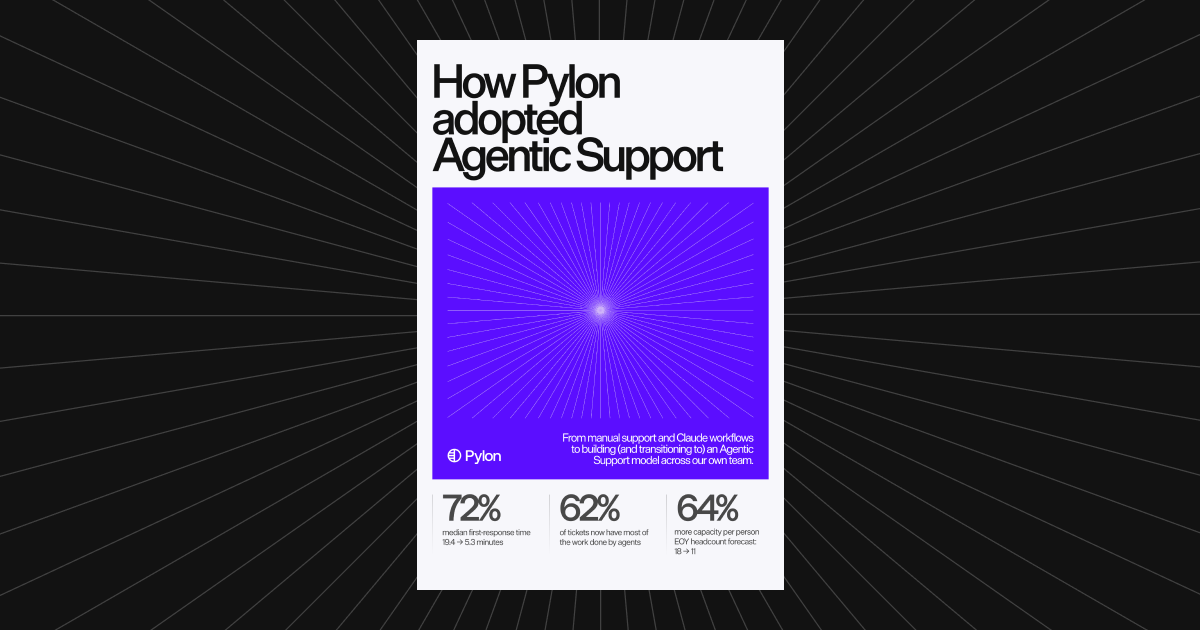
How we use it ourselves: On our own team, a 30-minute investigation now takes about 2 minutes to review and approve. In the 4 weeks after rollout, Support ran 773 codebase searches, and questions in our internal #product-helpdesk Slack channel dropped by about 50%. Full story: How Pylon adopted Agentic Support.
Pricing and limits: Professional is $89 per seat per month and Advanced is $139 per seat per month, on an annual contract. Enterprise is a custom quote. Agentic features run on credits, available pay as you go or as a committed plan, and you can top up in Pylon anytime. There's a minimum seat count and no free plan; free trials are set up through sales. If your support is mostly simple consumer questions, a B2C-focused tool may fit better.
Pylon is trusted by 1,800+ B2B customers, including Airtable, Amplitude, Applied Intuition, Cognition, Linear, Together AI, and Ashby. See Pylon facts.
Is Fin a good fit for B2B support?
Fin is one of the best options for automated resolution at scale on questions a knowledge base can answer. Fin is the company formerly called Intercom, and Salesforce completed its acquisition of Fin on September 10, 2026. The help desk is still called Intercom.
Fin reports averaging 76% resolution across 12,000+ customers. It runs on the Intercom help desk or alongside another help desk, and it uses Procedures to follow multi-step workflows.
Pricing: per outcome, charged at most once per conversation, with a monthly minimum when Fin runs on another help desk. Copilot is a separate per-user add-on. See current prices in how much B2B support software costs.
For B2B: per-outcome pricing grows with volume, and deeper account and engineering context depends on what your team connects.
Are Decagon and Sierra a good fit for B2B support?
Usually not as a first pick for B2B. Both build branded customer-facing agents for large brands, neither publishes a price list, and neither is a help desk, so escalations land in the help desk you already run.
- Decagon offers agents across voice, chat, and email, built with Agent Operating Procedures (AOPs). Its site lists financial services, travel and hospitality, healthcare, technology, retail, telecommunications, and insurance.
- Sierra deploys one agent across chat, SMS, WhatsApp, email, voice, and ChatGPT, and uses outcome-based pricing. Customers shown on its site include ADT, CarMax, Redfin, SiriusXM, and SoFi.
Is Zendesk AI a good fit for B2B support?
It's the easy choice if you're staying on Zendesk. Zendesk includes AI agents for messaging and email, voice with Zendesk voice, and an AI agent builder. Costs add up across seats, automated resolutions, and the Copilot add-on. See current numbers on each vendor's page, and ours on the pricing page.
FAQ
What is the best AI agent for B2B customer support in 2026?
For a B2B mix of simple and complex issues, Pylon, because its agents work inside the help desk with account, CRM, call, and codebase context. Fin is strong for high-volume questions a knowledge base can answer.
What is an AI help desk?
An AI help desk is a help desk with AI agents built in, so agents and people share the same queue, issue history, and account context. Pylon, Zendesk, Freshdesk, Salesforce Service Cloud, and Intercom with Fin are examples.
How much do AI support agents cost?
It depends on the pricing model. Fin charges per outcome, Zendesk charges per automated resolution beyond what plans include, and Decagon and Sierra don't publish prices. Pylon is priced by seats plus agentic credits, with no per-issue fees. For current numbers, see how much B2B support software costs.
How much does Pylon cost?
Professional is $89 per seat per month and Advanced is $139 per seat per month, on an annual contract. Enterprise is a custom quote, and agentic features run on credits.
Is Pylon an add-on to Zendesk or Intercom?
No. Pylon is the help desk itself: ticketing, SLAs, knowledge base, channels, and AI agents in one B2B support platform.
Fin vs Decagon vs Sierra: what's the difference?
Fin is an AI agent priced per outcome that runs on the Intercom help desk or alongside another help desk. Decagon and Sierra build branded customer-facing agents for large brands. Neither publishes a price list, and neither is a help desk, so escalations land in the help desk you already run. Pylon is the help desk itself, with agents built in.
What context should a B2B AI agent have?
More than a knowledge base. It should see the account and its history, CRM activity, what was said on customer calls, open bugs in your issue tracker, and ideally the code. Pylon connects across 13 integration categories, and agents can connect to any MCP server.